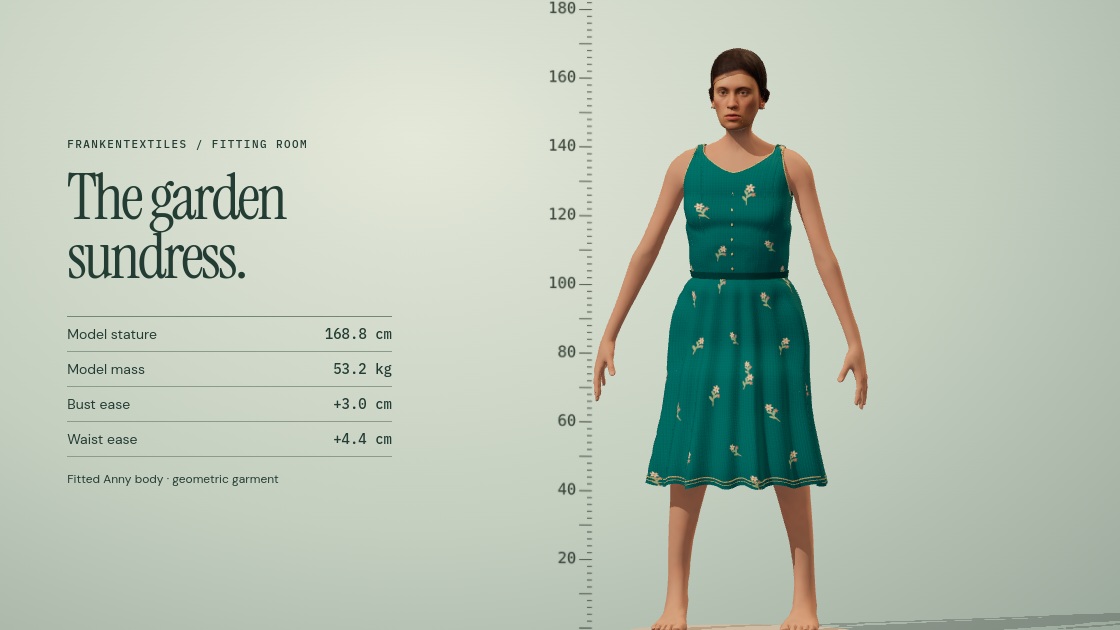
Dress study
The drape room
Cloth in
motion.
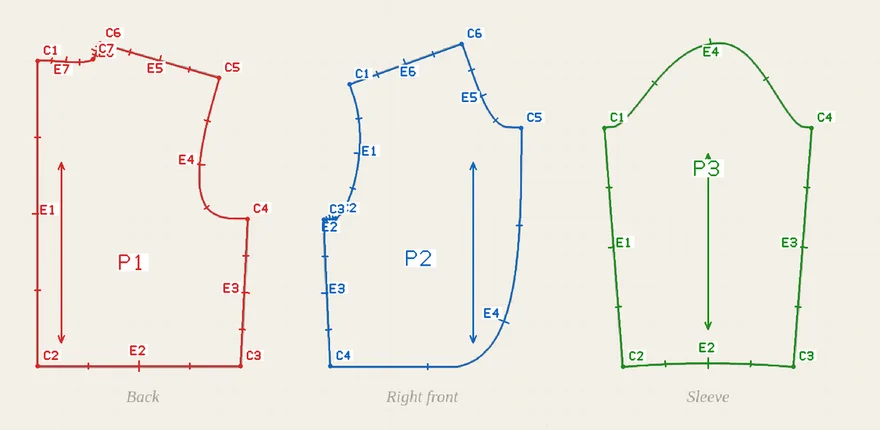
Five flat pieces become a wool bolero. Change the figure’s chest or raise its arms to see where the sewn cloth pulls closer.
Zouave bolero

Fitted chest52.0 cm
Mean chest gap20.6 mm
Edge strain P950.19 %
Loading 3D…
How the cloth was simulated Settled
Each combination replays a separate FrankenTextiles run with the same pattern and fabric. The first 88 frames illustrate assembly. The final 48 show native sewing and gravity steps on the fitted synthetic 92 cm form. The readings above describe the endpoint. The wool trim and AI-generated facial coloring are illustrative.
The mean gap averages the distance at the chest ring. Edge strain is the change in edge length over the whole garment. This run’s endpoint range is -4.36% to +4.06%. Contact shows the magnitude of the body’s barrier force at each welded cloth vertex, in newtons. Physical fit requires a sewn sample.
The trousers are shown at their own drape endpoint on the identical posed body. Each garment was solved separately. Interactions between the two layers were outside these runs.
Interactive garments
The wardrobe.
Take a garment off the rail. Turn it around, change the figure, or look beneath a layer.
The worktable
Hands-on studios.
Change a parameter. Inspect the result. Take the actual pattern, cutting marker, or stitch file with you.
Drafting and checking locally…
Cut piece
Preparing the pattern…
Cut Stitch
Compare two drafts at the same scale.
Material studies
Cloth under load.
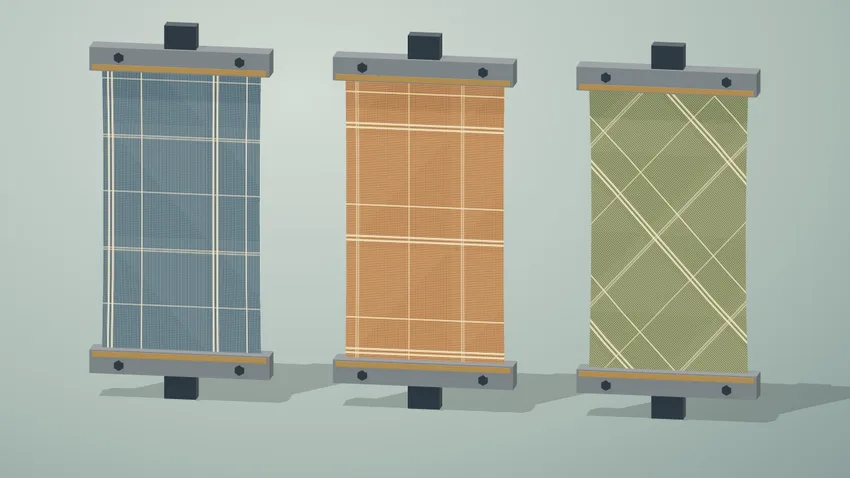
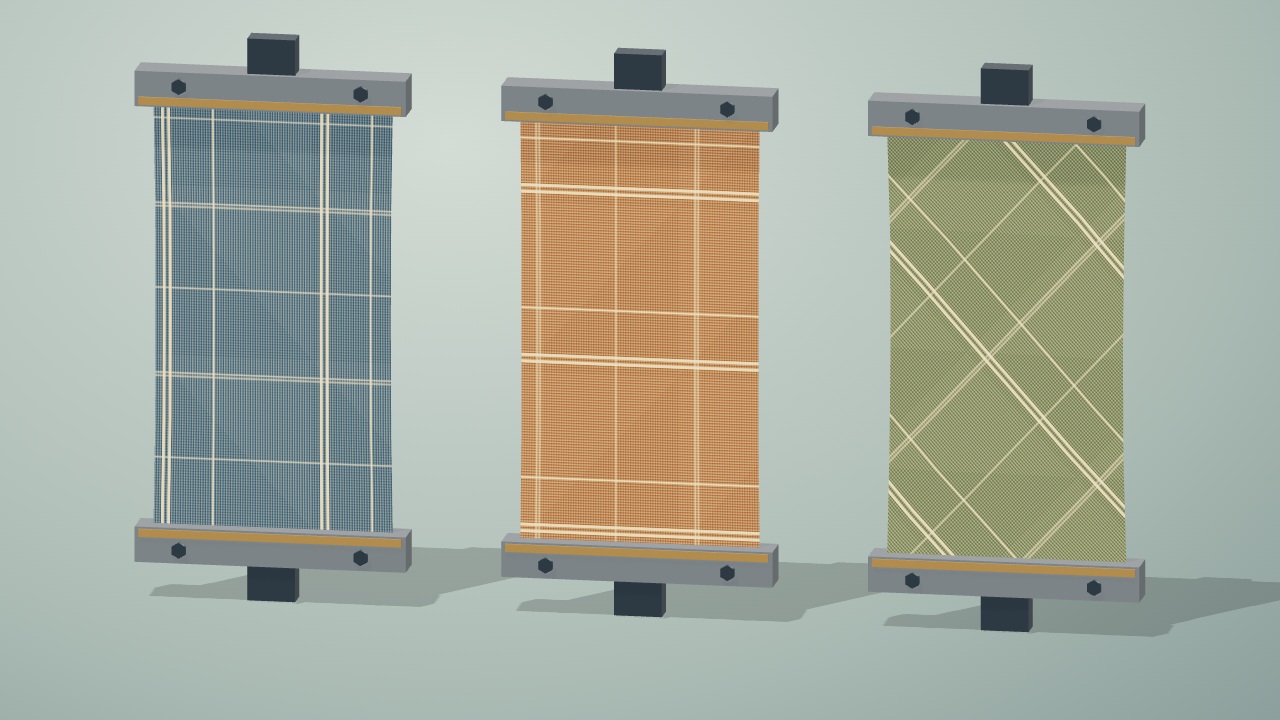
Two experiments from the Rust solver. Move the grips and see what changes in the cloth.
Cloth in three dimensions
The drape gallery.
Raster tracing
Read the lines.
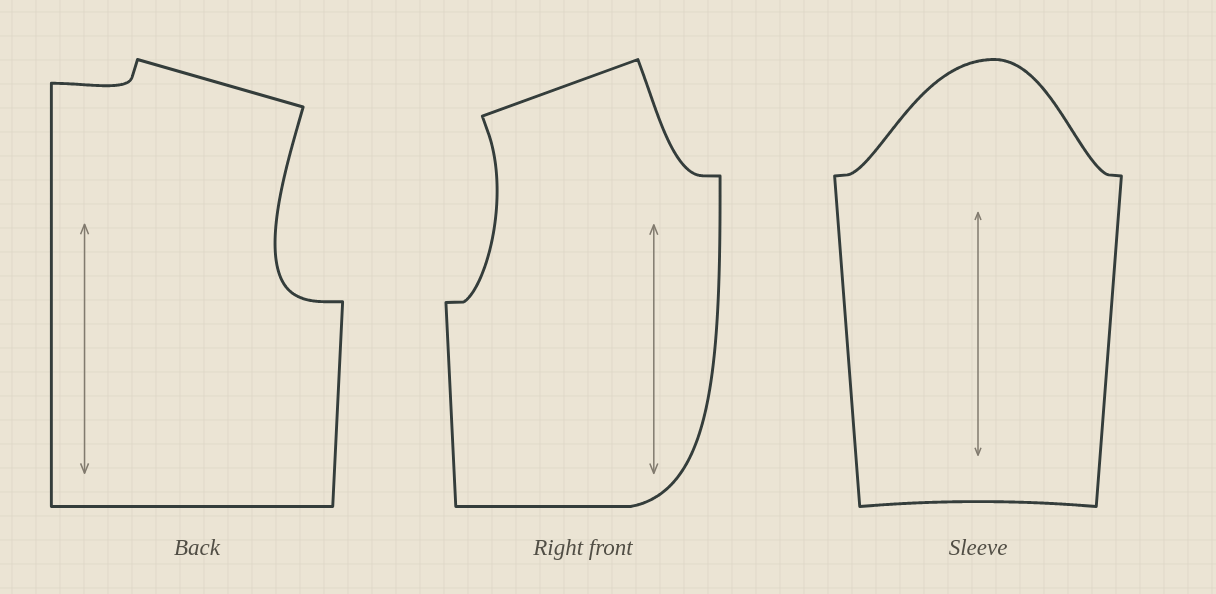
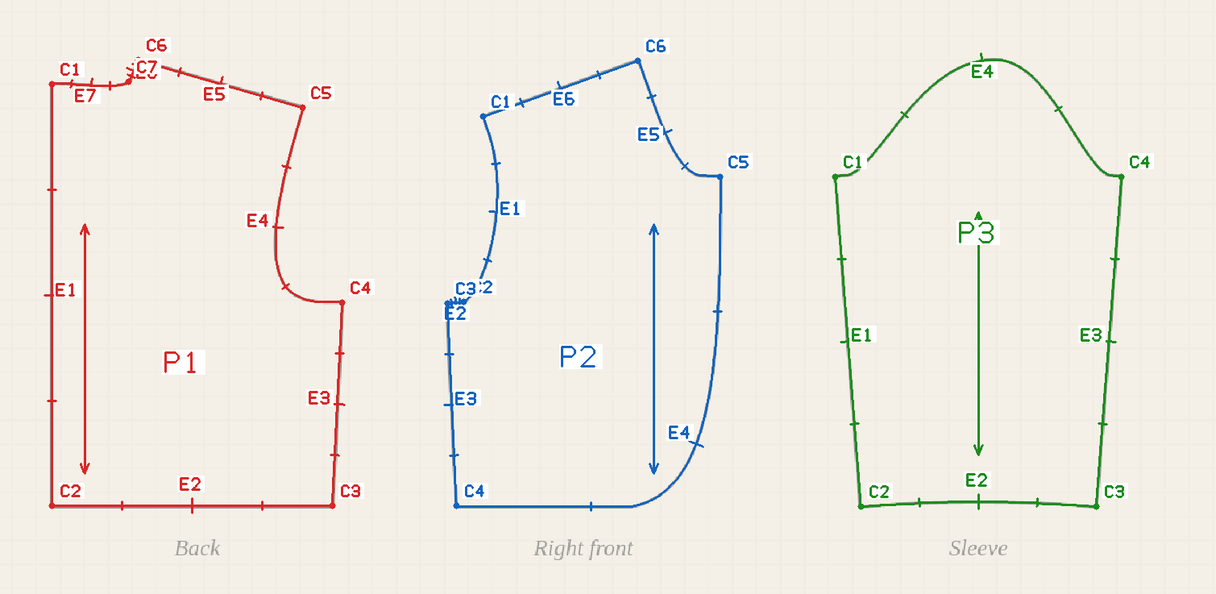
Slide across this synthetic bolero sheet to see the piece outlines, corners, and grain directions recovered by the Rust tracer.
- Pieces found
- 3
- Scale
- Unscaled
Run FrankenTextiles in your browser
The workbenches.
Each opens with a working example. Load your own files when you’re ready. Everything runs on your device.