Material Workbench
Inspect a fabric’s source measurements, assign it to a pattern and see which calculations the evidence supports.
Browse fabrics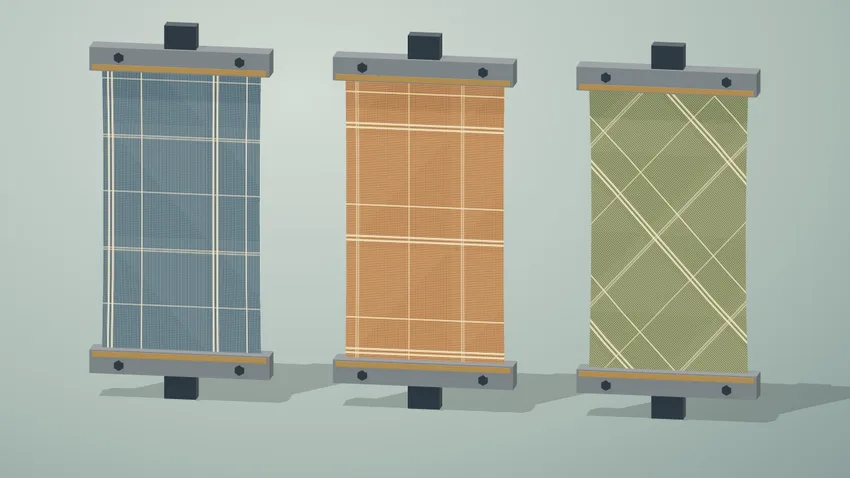
Loading local engine…
1. Inspect materials
Studio example · Softened linen on a bolero
Edit or import the source selection
Estimates stay disabled unless this selection explicitly sets allow_estimates to true. A digest-locked selection cannot be edited in place; author a new selection deliberately.
Original observations, normalized units and sources
Prepare a bounded membrane approximation from published fabric stiffness
Use an inspected Wang et al. (2011) fabric with source-qualified stiffness at zero strain. This creates an estimated local membrane law for the ordinary material consumers. It does not reproduce the paper's complete nonlinear model or supply missing bending, thickness, friction or thermal properties.
Inspect an exact source selection before preparing an approximation.
The inspected selection must already set allow_estimates to true.
To change that policy, author and inspect a new selection; never edit a digest-locked selection in place.
Changing the selected source resets this confirmation. Changing approximation inputs withdraws the prepared result.
Material temperature and dry heating / cooling
Uses the exact selection above, including its estimate policy. Inspect effective thermal resistance, areal heat capacity and the common source temperature interval. Download the source report and frozen selection for reuse; temperature-dependent laws refuse extrapolation and missing heat capacity stays unavailable.
The file supplies its own ordered material selections, interface resistances, area, reservoir temperatures, separate films, initial material temperature, cells per layer, time step, step count and trace interval. Optional source-qualified exterior exchange is retained. This runs without a garment or body model and does not use the selection editor. Inspect signed heat and stored energy, browse every retained time and cell, and download the exact report, original input and frozen replay. Refine the time step and cell count to assess numerical convergence. These dry one-dimensional results do not establish garment warmth, comfort, moisture transport or seam heat storage.
Compression and heat histories
The request supplies its exact specimen, loading branch, pressure observations and target pressure in pascals.
Interpolation requires explicit consent. Properties without pressure qualification remain unavailable.
Alternatively, ftx-compression-stack/1 supplies layer branches, a known initial pressure, clearance and fixed reference area:
it solves common normal pressure between rigid parallel faces and reports signed work, not generated heat.
Enter the exact layer ID to select; every layer's frozen selection is available for download.
Heat histories (ftx-compressed-thermal-history/1, /2 or /3) retain cell temperatures
across compression changes and thermal holds. Version 2 supports explicit source-qualified
links for loading/unloading branch changes. Version 3 additionally lets each hold prescribe pressure
in pascals or gap in metres; the selected material branches determine the resulting thickness or pressure.
Review the prescribed boundary alongside chronological heat and external work,
and keep the full report with its original input; a final selection alone is not saved heat state.
These local column calculations do not solve 3D garment contact or qualify presser-foot clearance.
Laundering and dimensional treatment
A material request retains the exact fabric, process, cycle count and measured directional change. A piece-treatment request uses the current frozen pattern when available, otherwise the original loaded pattern. Treat mode applies shrinkage and selects the independently characterized post-treatment material; compensate mode enlarges the cutting seam lines in the original material. Review fresh seam checks and download both the original and derived patterns. Missing post-treatment properties remain unavailable. Seam allowances remain authored manufacturing choices; this does not simulate washing forces or constrained shrinkage of an assembled garment.
Potential evaporative transfer
Accepts ftx-vapor-stack/1, ftx-vapor-coverage/1 and
ftx-vapor-coverage-history/1. Frozen coverage and motion-history replays include their
retained geometry, material sources and boundaries, so they run without loading a body model.
Download a replay from a scenario result and open it here to repeat its covered-region calculation.
For a stack, supply the ordered material layers, area, inside/outside vapor pressures in pascals,
boundary-film resistances and latent heat in J/kg. The shared material engine uses each layer's
source-qualified vapor_resistance and reports potential latent heat and water transfer,
with every pressure drop, measurement protocol and frozen material source retained. Complete source-reported
resistance bounds also produce conditional transfer ranges; missing bounds leave the nominal result available.
Different reported protocols require explicit admission in the request. Estimated material observations
require their own selection consent. This fixed-resistance, isothermal calculation does not determine
sweat availability, actual wearer cooling, condensation or garment comfort; it does not add an
evaporation term to the separate dry-heat simulation.
Identify behavior from swatch measurements
Linear swatches use ftx-swatch-calibration/1 with observed deformation gradients and nominal force per reference width.
Directional bending uses ftx-bending-calibration/1 with measured curvature and moment resultants; optional
fit_preferred_curvature identifies the unloaded curvature when the observations support it.
Both retain independent FIT and CHECK errors and publish the same source-locked material used by the garment solver.
Friction uses ftx-friction-calibration/1 with corrected steady sliding forces, positive normal loads and nonzero slip velocities.
Choose the matching target.kind: pair, self_contact or body.
Body and self-contact fits prepare a material selection. A pair fit retains both original material snapshots and prepares separate interface evidence
for the contact-pair controls in section 2. A declared body surrogate does not become measured human-skin behavior.
Clamped strips use ftx-strip-calibration/1 to solve the finite specimen and compare total grip forces and optional mid-gauge chord widths.
Declare the warp axis explicitly and qualify the width measurement in the acquisition method. The fitter checks independent held-out acquisitions,
mesh refinement and replay inside the fitted strain domain. An optional response_family supplies
source-qualified warp, weft and shear curve shapes; identification then fits their three dimensionless scales and signed normal coupling.
Curve shapes and strain knots are supplied assumptions, not learned from these strip observations.
Estimated shapes require response_family.allow_estimated_shapes independently of observation and fitted-output consent.
Both scalar and nonlinear laws are reversible;
failed acceptance gates retain diagnostics without an assignable selection.
To identify physical-area response jointly with the directional law, add
area_response: {"mode":"identify","parameter_bounds":[[10,50],[5,35]],"area_ratio_range":[0.65,1.45]}.
These illustrative search bounds are not textile measurements. A fresh fit needs the explicit positive J interval containing one;
any existing area law further restricts it. With a scalar orthotropic base, also supply
scalar_green_strain_range with three trial intervals spanning negative and positive Green strain. Omit that field when supplying
response_family or nonlinear. Accepted support comes from FIT observations and verified replay;
CHECK cannot widen it. Use mode: "preserve" only with an independently qualified existing area law.
The request owns the specimen, acquisition method, conditioning, fit/check partitions and error budgets.
Nonlinear swatches use ftx-nonlinear-swatch-calibration/1; timed histories use ftx-relaxation-calibration/1.
A timed request declares its independent equilibrium response. Directional recovery uses either supplied
orthotropic.times_seconds or 1–3 nonoverlapping orthotropic.time_bounds_seconds windows
within which times are identified. Supply only one of these; the report distinguishes fixed times from a bounded search.
Proportional recovery uses its separate top-level time bounds.
Estimated input observations and replacement of an existing law
require separate consent in the file. The checkbox only admits the fitted output estimates; missing mass, bending or contact data stay missing.
A timed calibration may supply plastic_equilibrium with
initialization: "pristine_reference" and an independently qualified
parallel_green_maxwell_plastic/1 network. The existing material must already contain
the independently characterized elastic, yield and hardening observations. Every acquisition starts
at zero Green strain and replays all recorded nodes, including those without force observations.
Only the Maxwell branches are fitted; the permanent-stretch law stays fixed. Estimated network evidence
needs its separate allow_estimated_network consent. Accepted output uses the ordinary combined material model.
For permanent stretch, upload ftx-membrane-plasticity-calibration/1 with complete
source-qualified loading/unloading cycles, raw Green strains and second-Piola sheet loads.
Supply independently characterized elasticity, total/accumulated strain limits and explicit yield/hardening
search ranges. FIT chooses the coefficients before held-out CHECK replay. Unexcited directions, incomplete
searches and failed checks retain a report without an assignable selection.
To identify both permanent stretch and delayed recovery from the same histories, include
joint_relaxation with one proportional Maxwell branch, positive stiffness-ratio and recovery-time
search bounds, a source-qualified network declaration and its strain domain. No provisional recovery
coefficients are required. The shared fitter checks excitation of all eight unknowns and replays every
recorded strain/time node. The result distinguishes jointly identified recovery from an independently
supplied spectrum that stays fixed. Fitted coefficients remain estimates.
Review fit and held-out errors below, then assign the exact identified selection in section 2. Download the complete report, original input and frozen selection for reuse. No specimen data leaves this tab.
Clamped-strip acquisitions and inverse identification
Inspect the retained loading/unloading curves, source hashes, protocol and original metadata. Optional original transverse observations retain their source README and unresolved spatial sampling. Grip extension, total force and transverse compression fractions remain their original measured channels; no local strain, solver width or Poisson ratio is inferred.
Declare grip extension over time to inspect force relaxation, recovery and permanent stretch. The same cloth solver retains material history and inertia at each accepted step. Source-qualified mass and a supported membrane law are required; a grip history does not identify missing material properties. The complete report separates stored energy, free-vertex motion and physical dissipation.
Wrap a source-qualified fabric around rigid cylindrical holders with explicit pretension offset, tare subtraction, grain orientation and timestamped twist, compression or stretch-slip waypoints. Reports upper/lower reaction force (N), axial reaction torque (N·m), protocol rate discrepancies and frozen replay JSON; never promotes uncalibrated catalog specimens to garment mechanics readiness.
Each request supplies its specimen, gauge, width, material-axis orientation and numerical controls.
Identification also requires complete FIT/CHECK acquisitions, explicit parameter bounds and model/error budgets.
This dedicated control uses the request's allow_estimates value to admit fitted outputs, defaulting to false;
allow_estimated_observations remains separate. The response selector above uses its own output-admission checkbox.
Review candidate coefficients, held-out residuals, local sensitivity, mesh changes and any rejection reasons below.
Only an accepted result publishes a frozen selection for section 2. These planar ideal-grip calculations do not identify
wrinkling, grip slip, bending, rate dependence or hysteresis.
Identify caller-selected canonical orthotropic membrane and isotropic hinge-bending parameters against the
3D cylindrical-holder shell model with isometric polygon chord radius, pretension offset, tare subtraction and held-out
CHECK replay. Uses the request's allow_estimates flag to admit fitted outputs (default false);
never promotes pressure-specific reported_thickness to unloaded contact thickness or fabricates
missing body friction, hysteresis or clamp-slip mechanics.
2. Bind the same pattern
No pattern loaded. Export pattern.json from the drafting page or load an existing pattern.
Import evaluated GarmentCode panels and stitches
Supply UTF-8 JSON; each input is limited to 4 MiB. This imports already evaluated panels and stitches, not a design program or a garment mesh.
Review the missing construction information, source mapping and limitations below before choosing Use imported pattern.
Every imported panel remains one physical piece. Conversion stays REVIEW_REQUIRED; it does not establish fit,
recover omitted garment components, or supply missing material properties.
Download the original inputs, converted pattern and import report. If annotations include a fit specification, you can select it when adopting the pattern, or choose your own under Fit, exports and mechanical drape. After adopting the pattern, assign materials and freeze selections to use the existing consumers. Changing an import input withdraws its review, adopted pattern and any fit specification still selected from that import.
Working with multi-garment outfits
A ftx-outfit-drape/1 request composes independently authored garments for one contact solve.
The original request and source correspondence remain downloadable; the exact composed pattern drives assignments and every consumer below.
Choose a whole garment, every outfit piece, or an individual piece for substitution. Garment-prefixed piece names keep independent seams and accessory attachments separate. Joint drapes require cloth self-contact;
scenario requests must also supply options.self_contact. Placements and layer order must already be authored.
No pending substitutions.
Source-piece assignments affect all mirrored/cut instances of that piece. Roles, grain and seams stay fixed. When swapping contacting textiles, supply the matching measured or explicitly admitted fitted interface evidence below.
A supplied list replaces the complete interface table in the same operation as the material assignments.
Each pair must identify the exact selected material snapshots and retain its sources and independent estimate consent.
An empty list [] explicitly removes all pairs; omitting a replacement preserves the original evidence.
Keep the original pattern's interface evidence.
No current calibrated contact pair.
Staging preserves the other contact pairs and checks the final assigned material snapshots. It does not replace the inspected material selection. Freeze selections & bind to use the staged pair with the current garment.
Save the current default, piece assignments and interface choice together as one alternative. Later draft edits leave saved configurations unchanged. Add up to seven alternatives, including individual materials, then compare them below. The unchanged original pattern remains the baseline; saving does not certify material or contact readiness.
Open the current bound pattern in Pattern Workbench's ordinary checks and alteration controls. The exact pattern stays local. Select wearer and fit evidence there, then explicitly check; material binding does not establish measurement readiness or physical fit.
3. Recompute supported consumers
The body check uses only its selected body evidence. Garment operations use the current bound pattern. Each checks its own missing-data and geometry constraints; changing inputs withdraws affected outputs immediately.
Fit, exports and mechanical drape
Add measurement evidence for this wearer
Up to eight files, 16 MiB combined. Original records and uncertainty enter ordinary fusion for exports, drapes and studies using these measurements. Photo estimates remain PHOTO_ESTIMATED. Separate body-request studies use their own evidence. Added records do not establish readiness or physical fit.
Using the supplied imported fit specification. Inspect it below, or choose a file above to replace it. Measurement readiness and physical fit remain separate.
Save the garment dimensions to compare against the selected body. Every band below is finished garment minus body, in millimetres; negative ease is an explicit design choice. No ease recommendation is supplied.
Explicit body-value transformation
The compared body value is measurement × multiplier + offset. The initial 1 and 0 keep the selected reading unchanged.
No fit targets saved.
Only saved targets are used. Editing the fields leaves them unchanged until Save or Replace. Use exact physical instance, vertex and edge names from the pattern: paired pieces use .R and .L, and unfolded edges use their .R/.L names. Landmark lines use the pattern's authored placement. The engine checks every reference, seam, outline and available body reading; missing evidence cannot pass. These targets do not establish physical fit, comfort or safe ease. A new source pattern clears saved targets; adopting an evaluated design retains them for the next explicit check.
Reuse an accepted image-fit shape for body checks and draping
The original accepted shape must match the selected model. It is reused without tape refitting; image-frame poses are not garment poses. A refused report or start never falls back to tape fitting. Current measurements remain the independent export and readiness evidence. Model predictions and a successful drape do not establish physical fit. Body-dependent studies below have an explicit source choice.
Needs the body model and measurements, or an explicitly associated accepted fit. No garment or material binding is needed. Comparisons use the model's measurement pose; drape angle and contact remain separate. Predictions remain MODEL_FIT. Differences, missing sections and a successful check do not establish readiness or physical fit.
Applies to tape-fitted or accepted shapes. The default is 35°. Body checks and tape fitting retain their measurement pose; studies below use their separately selected body source.
Retries a stalled step as smaller steps without extending simulated time. The trial limit covers sewing, draping and settling, separately for each start. Exhausting the limits refuses the run.
Leg fraction moves from standing (0) to the full selected posture (1), keeping the fitted shape and arm angle. Extra settling continues the sewn garment until its quiet window or the step limit; 0 keeps the fixed schedule. History-dependent materials require a fixed-duration run and refuse automatic settling.
Cutting, purchasing and sewing
Set maximum_marker_length_m in the options to place complete pieces across separate markers within a cutting-table or continuous-cut limit. Purchasing normally combines markers of the same material into one order; optional supplier allocation can distribute whole markers across qualified offers.
To fill unused space across those markers, add nesting.consolidate_markers: {"work_limit":100000}
to the nesting options. The bounded search tries to absorb a complete later marker into an earlier same-material marker without
increasing its stock length. It retains grain permissions and cutting gaps. The report shows saved stock length and work used;
an exhausted search retains a complete layout and does not establish a globally optimal cut plan.
For a qualified knife program with declared fixtures, add
program.travel_routing: {"model":"fixture_box_visibility/1","waypoint_offset_mm":1.0}
to allow checked raised-tool detours. The positive offset places candidate waypoints around fixture bounds;
the supplied tool envelopes still determine clearance. Previews and modeled travel times include the selected
detours and return. A bounded search can refuse without proving that every possible route is blocked.
Set program.stock_loading: [{"marker":0,"lower_left_mm":[20,10]}] to place a marker's
whole stock bounding box at an explicit machine-bed location. Marker indices start at 0. The entire stock must fit the bed;
cuts, fixtures and raised travel use the retained translation. Omit this option for the existing origin placement.
Set width_basis: "reported_lower_bound" to plan inside the lower endpoint of each roll material's
source-reported width range. Missing bounds refuse this option. The preview and report retain the narrower layout boundary;
marker length and purchasing are recomputed. Nominal purchase width, invoiced area and nominal stock mass keep their original
meaning. Omit this option for nominal-width planning. Finite hides and remnants retain their supplied polygons.
Use ftx-finite-stock-request/1 for individually identified hides or remnants. Supply the actual boundary, exclusions and preferred cutting axis; each item must match the bound material. No roll width is invented.
The identity report supplies exact physical-stock and material hashes for reviewed offer bindings. Use ftx-finite-stock-pricing/1 to price the current stock request's layout. This separate pricing file does not change the layout objective. Missing required offers keep the complete total unknown; no stock is reserved or purchased.
Use ftx-cutting-job/1 or /2 to route every piece to rolls, hides or remnants in one job. The shared planner retains complete physical inventory, independent process and purchasing outcomes, and frozen replay inputs. It does not authorize machine execution.
For observations within a day, use ftx-textile-quotes/2 with source observed_at instants
and supply an explicit as_of_at in the market scope. Times use UTC with up to nine fractional-second digits;
the retained observed_on and as_of dates must match them. Version-1 books keep date-only behavior.
The latest observation at the requested time controls availability and expiry; an older offer cannot fill a gap.
To fulfill a job across multiple suppliers, add
split_orders: {"schema":"ftx-cut-order-allocation/1","max_search_nodes":50000}
to the market scope. The bounded search assigns each whole marker once to an exact revision-locked offer,
applying minimum quantities, increments and observed capacity to each selected order. It never splits a marker
or pools stock across material revisions. Review the selected complete cost separately from the proven least cost;
a work-limited feasible result does not prove an optimum. These are dated observations, not stock reservations.
Inspect and download the canonical stitch geometry in two independent flat source frames. Each configured or routed cell uses its own retained machine, qualifications and operation geometry. These source frames do not establish machine registration, physical seam quality or authorization to execute hardware. A preview refusal preserves the complete sewing result and its downloads.
To compare recipes or routes directly, enable the choice above and load an
ftx-sewing-selection request in the same file input. Declare the objective, candidate recipes
or fixed routes, work limits, qualifications and any deadline. Review every trial, the selected complete
order and whether the listed optimum was proved. Download the exact selected options and their stitch
paths for replay. If no candidate qualifies, the result retains the diagnostics and produces no stitch
program. This does not authorize machine execution.
For configured cells, a parallel policy with
objective: "minimize_feed_milliseconds" and feed_time_search: {} searches for the least total scheduled feed work.
An optional feed_time_search.completion_deadline_milliseconds limits complete job finishing time.
Independently staffed cells round feed upward once per used cell. A qualified shared_operator
uses ceil_operation_feed_milliseconds/1 and keeps each operation's own feed slot while enforcing
the operator's attendance, calendars and any shared fixture pools. Completion, setup and handling remain separate.
Use ftx-sewing-selection/9 with objective: "minimize_parallel_feed_milliseconds"
to compare qualified recipes using the same allocation objective. The result shows the selected feed, its independent
lower bound and proof separately from makespan. A completed search over retained operation orders alone does not prove a global minimum.
To reduce needle and thread changes, add ordering to the recipe with
objective: "minimize_setup_changes" and an explicit max_search_nodes.
The bounded planner preserves declared predecessors and every stitch pass. The result shows the
original and selected change counts and whether the minimum was proven. Supply an optional
initial_setup with exact needle and thread identities to include the first change.
Add consumables: {} to request thread quantities from the selected sewing plan.
Each admitted qualification needs independently sourced thread_consumption with every required channel,
an exact frozen yarn selection, consumption per traversed interval and explicit start/end allowances.
Optional consumables.purchasing supplies its own dated quote book and market.
Missing channels or eligible offers keep complete quantities or prices unknown; partial diagnostic rows are retained.
Thermal exchange on this drape
Run a fresh drape above first. Author explicit uniform conditions or retain an original request. The same section-3 conditions can also be used in material comparisons below. No environmental or material values are inferred.
Uses each piece's retained vapor resistance and current draped area with the supplied vapor pressures and boundary films. Results are independent sheet potentials; they do not establish sweat availability, layered body evaporation or cooling feedback into the dry-heat simulation.
Supply explicit paths on the retained drape mesh and source-qualified excess conductance for the exact material stack and reservoir films. Coverage reports keep the unbridged baseline, seam/closure excess and combined power separately. An incompatible material, geometry or qualification refuses this heat result; no seam benefit is inferred from a name.
4. Compare material alternatives on the original pattern
Run a source-qualified shortlist, then compare real manufacturing and simulation outcomes side by side. Every alternative starts from the original pattern loaded in section 2, not its current bound preview. No binding step is required. Refused consumers remain visible; missing prices, mass or heat never become zero.
Screen and compare manufacturing
Add property limits and independent objectives
Limits use the displayed canonical units: 100 g/m² is 0.1 kg/m²; 1 mm is 0.001 m. Add at least one limit or objective for a property. Method and condition text must match the observations exactly. Missing data excludes a candidate from that rule. No durability, warmth or safe-use threshold is supplied automatically.
0 property rules added. Only added rules run.
Search and physics requirements work without property rules. With multiple objectives, the engine reports the non-dominated alternatives without an invented weighted score. Reported-range mode requires complete source bounds for every requested observation. Inspect a result's exact source or add an eligible result directly to your garment comparison below.
The request declares units, constraints, objectives, nominal or reported-bound comparison and estimate consent. Its scalar frontier is not a garment ranking. Original observations and protocols remain inspectable for excluded candidates too.
Add eligible discovery results above, inspect individual materials in section 1, or save a complete configuration from section 2. The original pattern is always included as baseline. Individual materials use the shared target below; saved configurations retain their own default, piece assignments and interface evidence. Optional linked alterations also vary the geometry.
No comparison materials added.
Changing the default does not replace an explicit lining or cuff material. Choose every piece or exact pieces to replace those assignments. This target is unused when every alternative is a saved configuration. Current section-2 preview edits enter a comparison only when saved; they never change the original baseline.
The same allowance applies to the roll form and mass. Retained stock and job files keep their own policies; clear this override or make every supplied route agree. Leave blank to retain authored piece allowances. For mass alone, an uploaded inventory retains its own allowance; when cutting also runs, mass and every supplied roll or finite-stock route must agree.The generated request, original pattern, exact material selections and full results are available for download after comparison. Linked alterations require the selected body model; fixed-pattern manufacturing can run without one.
Use ftx-design-study/1 to compare pattern alterations alongside material choices.
Each named entry in designs contains explicit operations: slash_spread,
move, true_seam or cap_ease. Each starts from the original pattern;
the unchanged baseline is included automatically. Every design is crossed with the requested material
alternatives, up to 32 total candidates. Invalid alterations retain their refusal and cannot win a comparison.
Download each exact altered pattern, final material-bound pattern, and original study inputs for replay.
Choose Use … pattern on an evaluated candidate to make its exact final pattern and material
assignments the current workbench source. Review the existing body, fit and process inputs, then freeze and
bind before running exports, preview or manufacturing. Previous results are withdrawn, and subsequent
study alterations start from this newly chosen pattern.
For fit-driven alterations, use design_grid with explicit linked variable values and
design_fit with your fabric-fit/1 targets, then enable selected-body manufacturing here
or run the body scenario below.
Optional design_grid.fit_screening: {"max_candidates":64} checks a bounded grid prefix against
the selected body before sending up to max_designs passing alterations to manufacturing and simulation.
The report retains rejected designs, passing designs outside that allowance, and unvisited points separately.
The unchanged baseline is additional to the allowance. The selected model supplies the body measurements;
computed target compliance does not establish fit on a real wearer.
Both search modes can vary local shape with linked vertex sites:
{"op":"move","piece":"front","vertex":"shoulder","dx_multiplier":0,"dy_multiplier":1}.
Each scalar variable moves the named source vertex by its value times these x/y multipliers; at least one
multiplier must be nonzero. Combine move and slash sites in authored order to link front/back shaping.
Relative curves follow their endpoints; marks stay fixed. The ordinary seam, outline and fit checks still
gate every candidate before manufacturing.
To find alteration amounts between listed grid values, replace design_grid with
design_adaptive and retain the same design_fit targets. Set
objective: "fit_band_violation_mm", explicit bounds_mm, initial_mm,
initial_step_mm and minimum_step_mm for each linked variable, plus
max_evaluations and max_designs. The search uses unrounded fit measurements,
refines the steps when progress stops, and sends passing patterns to the existing consumers.
Every trial retains its exact alterations, body identity and fit result. A work limit or minimum-step stop
leaves unvisited alteration values unknown; the downstream comparison remains conditional on the designs found.
To guide that adaptive search with actual manufacturing or simulation results, set
design_adaptive.objective: "consumer_comparison" and design_adaptive.material_key to
one exact authored material alternative key. The study's comparison must declare
nominal or a supported reported_bounds basis and one objective with an explicit
minimize/maximize direction. Each constraint inherits that basis unless it declares its own
basis; for example, a bounded mass objective may retain an explicitly nominal strain guard.
Its constraints, required consumers and source rules
also gate every probe, after the ordinary flat geometry and selected-body fit checks. The search keeps better admitted
geometries instead of stopping at the first passing designs; each retained geometry is then crossed with all material
alternatives. A single body scenario can supply the objective. In named-case matrices, declare
design_adaptive.case_key to choose the guidance case; every case must still admit a retained trial.
Reported ranges must be strictly preferred to advance the search; overlapping ranges remain unresolved.
For one identical objective and basis across all cases, consumer_worst_case guides the worst case
without a case_key. Reported-range trials retain the aggregate endpoints and their original case witnesses.
The trial report retains objective readings, exclusions and exact patterns. Search
allowances do not override cumulative simulation budgets or establish a global optimum.
Build combinations of shell, lining, cuffs and other material choices
Inspect a material in section 1, select the source pieces that share a choice, and add it to a named group. Add more choices to that group, then create groups for other pieces. Every combination runs through the requested consumers.
In this mode, the study file supplies the schema, process inputs and comparison policy.
It must omit variants, screened and combinations. The downloaded request includes the exact frozen choices.
No material choices added.
The pool uses the existing interface records and exact material hashes. Each combination selects its matching pairs; missing friction evidence stays missing. Omitting the pool preserves the original pattern's interfaces. An empty list clears them. Up to eight groups may target disjoint source pieces, with at most one default group. Up to 32 complete combinations are evaluated.
Preview-pose tape fitting uses the arm angle, leg posture and fraction in section 3, including after additional measurement fusion. It fits the current measurements and does not use a selected accepted-fit report. Study solver settings and authored motion remain in the study request.
Guided linked alterations use this body source automatically. An advanced study requires design_fit
in its request, the section-3 local model and the selected body source.
The same source choice applies to fresh single-scenario and named-matrix studies. Reusing an accepted shape requires
the wearer association above; any current section-3 measurements are compared without refitting.
Uses the selected shape's MODEL_FIT readings without running cloth or heat.
Fit refusals remain visible and cannot rank; no physical fit or safe-ease claim is made.
The study request contains explicit variants, a screened request, or grouped combinations, and its own shared roll cutting,
finite-stock, sewing, declared assembly mass and dated purchasing inputs. Add finite_stock with an ftx-finite-stock-request/1
inventory to compare actual hides or remnants, including defects and prior cuts. Every alternative uses the same original inventory;
one alternative does not consume another's stock. Roll and finite-stock results remain independent, and purchasing uses roll markers.
The study does not use the single-preview process files above. Up to 32 alternatives;
scalar-frontier pruning requires explicit consent. Download source-locked alternative patterns from the results.
For one complete job combining roll textiles with hides or remnants, supply cutting_job
with schema ftx-cutting-job/1, explicit routes for every source piece and its own roll
and finite_stock inputs. This replaces separate cutting, finite_stock and
purchasing inputs. Each physical cut instance and copy is allocated exactly once; optional job purchasing
retains incomplete offers independently. Download the frozen job pattern and request to replay using cut-job.
To let a material change switch a piece between roll fabric and a hide or remnant, use
ftx-cutting-job/2 with material_routes. Each source piece lists its allowed exact material
snapshots and stock routes. The study selects the matching route after each material substitution and shows that
selection in the results. Supply stock and planner options for all declared choices; an unlisted material refuses.
Add optional vapor to recompute potential vapor transfer for each material alternative.
Its ordered layers name occurrence keys and targets such as {"scope":"piece","id":"front"}
or {"scope":"default"}; the final pattern assignments supply their materials.
Supply the common area_m2, inside/outside vapor pressures, film resistances, latent heat and source-protocol filters
as in the standalone vapor request. No body, roll width or mechanical coefficients are required for a vapor-only study.
The nominal objectives vapor_potential_heat_flow_w and vapor_potential_mass_flow_kg_s use this actual consumer;
required_consumers: ["vapor"] excludes unavailable vapor results. These potential rates do not establish sweat supply,
actual evaporative cooling or garment comfort. Each successful alternative includes a frozen vapor replay download.
For retained assembly mass, add assembly_mass with schema ftx-assembly-mass/1,
an explicit inventory_complete declaration and sourced extras masses. It counts every physical cut piece,
including unsimulated lining, plus retained thread, closures and other declared extras. A mass-only study needs no roll width or body.
Use assembly_mass_kg as the objective; missing components leave the total unknown. This is one pre-finishing assembly,
not stock waste, a simulated subset or a weighed finished garment. Mass and every requested roll or finite-stock cutter must use the same seam allowance.
Add an optional comparison to the study request with explicit basis: "nominal",
objectives, inclusive constraints and required_consumers. The shared Rust engine reports
the computed Pareto alternatives, exclusions and protocol-incomparable pairs separately from scalar screening.
Use basis: "reported_bounds" for assembly_mass_kg, constant steady-heat objectives,
vapor-potential objectives or final cumulative finite-water outcomes.
Steady independent_surface_power_w and body_coverage_power_w ranges require complete positive
endpoints for the selected constant resistance, or both thickness and conductivity. Geometry, reservoirs, films and fixed interfaces
stay fixed. Nonlinear conductivity, exterior exchange, bridges and consumed thickness-dependent gas gaps leave their nominal result
visible but cannot supply a bounded decision. Coverage includes explicitly declared bare-film paths, and reversed heat flow remains negative.
Mass ranges retain fixed authored geometry and inventory. Vapor ranges propagate complete source-reported Ret endpoints
with fixed geometry, boundary pressures, films, interfaces, latent heat and motion sampling. Finite-water ranges also hold
the declared initial liquid and supply fixed. Limits must contain the
whole range, and overlapping or touching ranges remain unresolved. Missing bounds exclude an alternative while its
nominal result remains visible. These are conditional reported ranges, not confidence intervals; other computed metrics
still require the nominal basis.
For purchasing with optional supplier allocation, selected_observed_order_cost compares the
complete feasible order found by the bounded search. observed_order_cost requires its least cost to be proved.
Mixed cutting jobs expose the corresponding cutting_job_selected_order_cost and
cutting_job_observed_order_cost. Missing or incomplete assignments never supply a partial cheap total.
Optional sewing_selection accepts a ftx-sewing-selection/1 feed-time request,
/2 feed-and-setup-time request or /3 thread-cost request instead of
sewing. Each material alternative searches its own source-qualified recipe choices; the report retains trials, work limits
and the selected plan. If no listed recipe qualifies, sewing remains unavailable for that alternative.
When the sewing plan includes source-qualified setup timing, use sewing_setup_seconds
or sewing_feed_and_setup_seconds as objectives or constraints. The existing feed_seconds
remains feed-only duration. Missing setup evidence leaves the new durations unknown; they do not include
undeclared handling or establish total production time.
When sewing or the selected sewing_selection recipe requests consumables,
use nominal thread_required_length_m and thread_observed_order_cost as objectives or constraints.
Require sewing_consumables for complete channel quantities or sewing_purchasing for complete exact-yarn orders.
The workbench shows the actual selected operation/channel requirements and retains qualified sources and canonical order details.
Thread purchasing has its own currency and market, which may differ from cutting. In a study, thread demand uses the cutting production count;
an explicit consumables.production_copies must agree. Standalone sewing accepts the same field and otherwise describes one garment.
Per-garment traversal and start/end allowances aggregate across copies before supplier minimums, increments, tiers and stock are evaluated.
Continuity remains a single operation/channel requirement, and sewing geometry, feed duration and setup schedules remain per garment.
Independent thread prices can use a different market from cutting; purchased length is not retained garment mass,
and time-based recipe selection does not prove a thread-cost optimum.
Set cut_and_sew_purchasing: true in the study to combine complete fabric and selected-plan
thread orders for the same production count. Use the exact same immutable quote book and comparable market for both.
Supply either ordinary cutting and purchasing or a complete priced cutting job; every fabric item and thread channel must be priced.
The nominal objective cut_and_sew_selected_order_cost and required consumer cut_and_sew_purchasing
use the complete selected total, including supplier rounding. Shared physical stock, missing prices or inconsistent markets refuse the
combined total while independent results remain visible. Complete bounded allocations remain usable with their proof status shown.
This merchandise total excludes labor, equipment, unrepresented trims and costs outside the declared quote terms.
To choose the recipe by thread purchasing cost, set sewing_selection.schema to
ftx-sewing-selection/3 and objective to minimize_thread_observed_order_cost.
Supply options.consumables.purchasing with the dated quote book and explicit market.
The search compares complete orders for each qualified job, including quantity thresholds and price tiers;
it can choose a slower recipe when its order costs less. Missing channel quantities or eligible offers remain unresolved,
and an exhausted search retains a complete incumbent without claiming the least cost is proved.
Fresh body, drape and heat studies
Use the body source selected above. Every alternative receives a fresh drape on that same body and pose. These controls author a numerical experiment; material qualifications, convergence and result admission remain with the engine.
In named-case mode, these controls prepare the next case. Save a named case below or explicitly replace a saved case. Changing a draft or choosing another source file leaves saved cases unchanged.
Supply the garment's own points-of-measure contract for fit reporting. Choosing no contract does not assess those targets or establish physical garment fit. The selected document is retained unchanged. Guided linked alterations still require the section-3 contract for their separate design-fit screening even when this scenario reports no fit targets.
Uses each alternative's fresh geometry and qualified thermal observations with the declared reservoir temperatures and boundary films. Independent sheet power is not layered body coverage, whole-wearer heat loss or a comfort score.
A named matrix evaluates the same design and material alternatives and body under 1–8 declared scenarios.
Use {"schema":"ftx-drape-scenario-matrix/1","max_evaluations":16,"cases":[{"key":"case name","scenario":{…}}]},
with each scenario containing an ordinary scenario request. Set max_evaluations from 1 to 64
to cover the complete alternative × case count. Each case can override comparison; otherwise it uses the study policy.
Manufacturing is shared once. Per-case outcomes and refusals remain separate, and the cross-case frontier requires
comparison policies for every case. Motion, conditions and consumer requests belong to each case. For joint outfits,
every case must explicitly enable options.self_contact. Download the original matrix and full report to replay it.
Uses the same study request and the local body model selected in section 3.
The selected Body source for body-dependent studies governs every study. Measurement mode fits
section-3 measurements at 35°. Accepted-shape mode uses the original report and ordinary arm angle above,
with explicit wearer association and optional current measurements. It needs no separately authored request file.
Separate-request mode instead owns its measurements, optional accepted_body_fit report and
arm_abduction_deg (0–180°, default 35°), legs (standing, seated, squat)
and leg_fraction (0–1, default 1); section-3 report, pose and measurement edits do not alter that request.
Accepted shapes must match the exact model and are never refitted; optional tapes report residuals only.
An absent or malformed selected source refuses without switching to another source. Choose measurement mode explicitly
to return to tape fitting. Original source text is retained in the downloaded body-input.json for replay.
Guided setup explicitly reuses the chosen fit and sheet-heat files above. Complete-file mode retains its own original fit specification,
numerical options, conditions and coverage policy. The single-preview leg posture, settling budget and self-contact checkbox
do not override either scenario policy. Shape selection runs once;
the chosen garment pose does not change that shape. Each alternative gets a fresh production drape and
current-geometry heat evaluation. Without a motion request this remains a static pose.
Motion keyframes accept an arm angle and optional leg_pose: {"posture":"seated","fraction":0.5}
with posture seated or squat and a fraction from 0 to 1.
Each endpoint keeps the fitted shape and continues the sewn cloth. Omitted leg_pose selects standing at that endpoint.
Use short pose increments: the checked path follows vertex chords between endpoints and can refuse intersecting geometry.
Scenario options.max_settle_steps reserves a bounded optional tail for the initial drape, before motion begins.
Optional scenario vapor_coverage computes layer paths from each new drape, using explicit
body-triangle IDs, instance-to-layer names, geometric projection settings and vapor-pressure boundaries.
The result reports covered-region potential transfer separately from uncovered body area and unassigned cloth.
It does not infer sweat supply or add evaporative cooling to dry heat. Download its frozen request for
thermal-vapor-coverage replay.
With motion, layered vapor coverage also follows every declared endpoint. To integrate its potential
over all accepted mechanical samples, add motion.vapor_coverage_history with
schema: "ftx-motion-vapor-coverage/1", integration: "right_endpoint" and
an explicit max_geometry_operations (1–20,000,000). It reuses the same vapor_coverage
source, layer and boundary policy. Results retain coverage and potential transfer at each sample plus an exact
thermal-vapor-coverage-history replay download. Use motion_covered_vapor_potential_energy_j
or motion_covered_vapor_potential_mass_kg as objectives, or require motion_vapor_coverage;
comparison requires the entire declared body domain to be covered at every retained state.
The potential integral follows the declared temporal rule and depends on motion resolution.
For finite body-side water, add optional wet_film to that history policy with
schema: "ftx-body-wet-film/1", the exact initial body_mesh_sha256, a source
and model basis, and one initial_liquid_mass_kg and supply_rate_kg_s value
per selected body triangle. The same policy works in standalone history replay. Each triangle retains its liquid
through pose and coverage changes; modeled evaporation consumes only available liquid. Results show liquid supply,
depletion, unmet demand and latent energy supplied by the prescribed body reservoir. These inputs do not infer
sweating, bare-body transfer, wet textile properties or latent feedback into textile temperatures.
To compare these finite-water outcomes, use nominal or reported_bounds objectives or inclusive constraints named
motion_wet_film_evaporated_mass_kg, motion_wet_film_body_reservoir_latent_energy_j,
motion_wet_film_unmet_demand_mass_kg, motion_wet_film_supplied_mass_kg or
motion_wet_film_remaining_liquid_mass_kg.
Requiring motion_wet_film also admits the complete source-bound water balance when optimizing another metric.
Every selected body triangle must remain covered throughout the declared history. The same metrics work inside named matrices;
an unavailable or inconsistent film excludes that case while its independent results remain visible.
For reported_bounds, the native comparator replays low- and high-demand Ret endpoints through the finite-liquid model
to bound final cumulative evaporation, unmet demand and latent energy; remaining liquid uses the reversed endpoints.
Declared supplied water is a fixed singleton range and needs no Ret bounds, although its complete nominal history must still pass admission.
Missing Ret bounds exclude the other bounded water metrics while preserving their nominal readings.
Geometry, boundaries, initial liquid, supply and integration stay fixed. These conditional final ranges are not confidence intervals
or general water-state uncertainty: the displayed history, accepted-sample ledgers and replay remain nominal, without per-interval water bounds.
Optional motion in the scenario (ftx-drape-motion/1) continues that same sewn cloth through
declared time/arm-angle keyframes, preserving velocities and material history. It uses the selected shape without refitting.
Each interval follows checked linear body-vertex chords, not a certified anatomical joint path. The report retains every accepted
adaptive substep, maximum panel-edge strain and independent steady endpoint heat.
Expand a successful result to inspect exact retained body/cloth samples from front or side at their recorded physical times.
The sample slider uses one fixed metric scale across the trajectory and both views; it does not interpolate missing states.
Failed motion publishes no partial trajectory; initial static results stay separate. Choose motion_max_absolute_edge_strain_pct to compare the maximum strain across the complete trajectory.
Requiring motion, transient_surface or transient_coverage excludes incomplete histories from the computed frontier.
Optional motion.transient_surface and motion.transient_coverage carry temperatures through every accepted sample.
They require sourced heat capacity plus their own initial temperatures, interval films and budgets. Coverage also requires exact body/layer assignments
and explicit exposed-cloth conditions. The results separately report physical stored heat, signed boundary energy and remap error;
these histories are not interchangeable with each other or steady power snapshots. A heat refusal preserves successful mechanics.
Either thermal history can independently request plastic_dissipation_heat: "uniform_reference_thickness",
relaxation_dissipation_heat: "uniform_reference_thickness" and/or
bending_plastic_dissipation_heat: "uniform_reference_thickness" when its materials supply independent conversion observations
for membrane yielding, Maxwell dashpot work or irreversible panel bending. Bending heat requires the material's
bending_plastic_heat_fraction in [0,1], matching specimen and conditioning, work basis
irreversible_bending_plastic_dissipation and an explicit qualified temperature domain. An explicit zero is supported;
an absent observation supplies no conversion. Set each option inside the thermal domain that should consume it;
the uploaded scenario owns these choices and the original JSON is retained for replay.
Accepted work follows the material through covered and exposed regions; each source keeps
its own work ledger and their heat is summed once. Initial forming work, reversible storage, numerical loss and bare body are excluded.
Motion heat objectives use transient_surface_ or transient_coverage_ with inside_energy_j,
net_boundary_energy_j, final_min_temperature_c or final_max_temperature_c.
Use min_sample_temperature_c or max_sample_temperature_c for extrema across the initial state and retained sample endpoints;
these differ from the final endpoint temperature and are not continuous-time bounds.
Select minimize or maximize explicitly: signed energy can reverse with the environment. Internal sources and boundary exchange contribute separately to stored heat.
The source-qualified liquid coupling below updates inertia without inferring wet material laws.
Body self-intersection, seated/squat and empirical ride-up qualification remain separate requirements.
Optional motion.transient_coverage.thermal_bridges includes seam and closure
excess exchange during motion. Use schema: "ftx-motion-thermal-bridges/1",
model: "qualified_zero_storage_centerline_exchange/1", an existing steady bridge request as
reference, and independent temporal qualifications for its exact paths and steady observations.
Each qualification must explicitly support zero storage, elapsed time, the full accepted sample interval and live textile
temperatures. Every endpoint rechecks actual centerline length, ownership, materials and films. Signed bridge energy
is added equally to both boundary ledgers; the baseline textile temperature and storage are unchanged. Ordinary
inside-energy comparison includes that excess. The result retains baseline and total energy separately, plus the
complete source and geometry history. A steady observation alone does not qualify this moving law.
Optional motion.transient_surface.surface_water enables source-qualified initial free-liquid
evaporation and temperature feedback on the textile. The ftx-textile-surface-water/1 request declares exact
instance/material bindings and initial loadings, liquid heat capacity and latent heat, a bounded pressure–temperature table,
ambient pressures and film resistances. Its independent source must qualify the fixed dry thermal and vapor observations
throughout that domain. Replenishment is explicitly zero. The result separates remaining water, latent cooling, vapor sensible
export and liquid storage; it preserves dryout events and refuses condensation or extrapolation. Without an explicit
mechanical qualification the liquid is thermal-only. No sorption or body sweat is inferred. Coupled histories can qualify existing nominal temperature
and energy objectives after complete source, geometry, water and energy admission. Add
textile_water_evaporated_mass_kg, textile_water_remaining_mass_kg or
textile_water_latent_energy_j as nominal objectives or inclusive constraints to compare the textile's own water.
These quantities are separate from body-reservoir water. Missing material qualification, inconsistent ledgers and incomplete
motion exclude the affected alternative; source-reported uncertainty ranges are not inferred.
Optional motion.transient_surface.mechanical_coupling connects that exact liquid inventory
to cloth inertia and gravity. The original ftx-evaporating-liquid-mechanics/1 qualification supports initial-only
evaporation. Use ftx-coupled-liquid-mechanics/1 with
co_moving_mass_exchange_frozen_mechanics/1 to include independently qualified supply and condensation.
Both require the complete material/interface report hash and every instance's source-qualified loading and temperature domains.
Initial water is admitted co-moving after the dry drape. Each accepted heat/liquid interval updates the next mechanical step;
refine the mechanical time step to assess this first-order model. Incoming and outgoing water share the local cloth velocity,
with separate momentum, kinetic and signed gravitational transfers; those energies are not latent or sensible heat.
Late source or thermal failure refuses the coupled motion. For independently qualified incoming momentum, use
ftx-coupled-liquid-mechanics/2 with one constant incoming_velocity_world_m_s per instance,
or ftx-coupled-liquid-mechanics/3 with
scheduled_incoming_velocity_mass_exchange_frozen_mechanics/1 and
incoming_velocity_world_m_s_by_interval: one world-frame vector per keyframe interval for every instance.
For separately qualified constant supply and condensation velocities, use ftx-coupled-liquid-mechanics/4,
phase_specific_incoming_velocity_mass_exchange_frozen_mechanics/1 and
incoming_stream_velocities_world_m_s with supply and condensation vectors.
For independently scheduled supply and condensation, use ftx-coupled-liquid-mechanics/5,
scheduled_phase_specific_incoming_velocity_mass_exchange_frozen_mechanics/1 and
incoming_stream_velocities_world_m_s_by_interval: one explicit pair per keyframe interval.
The constant, aggregate scheduled and phase-specific fields cannot be combined. Incoming water mixes with the actual cloth
and accessory inertia; outgoing water leaves at the mixed velocity in versions 1–5.
For qualified outgoing recoil, use ftx-coupled-liquid-mechanics/6 with
scheduled_phase_specific_incoming_and_outgoing_velocity_mass_exchange_frozen_mechanics/1 and both
the phase-specific incoming schedule and outgoing_stream_velocities_relative_to_cloth_m_s_by_interval.
Each outgoing entry has explicit evaporation and drainage vectors relative to the post-mixing cloth;
the retained cloth recoils to conserve momentum. Drainage additionally needs its independent water-process qualification.
Mixing loss and outgoing separation work stay separate from thermal sensible and latent heat. Material and design comparisons
require complete schedules and consistent source, phase and transfer ledgers. Pinned cloth coordinates, inferred runoff and
wet constitutive changes remain unsupported.
For serial production handling, provide production.handling with exact machine and
process qualification locks, independent timing evidence, initial loading, final unloading and every directed
operation transition for the same garment or a different garment. Select ordering objective
minimize_production_time with qualified setup times. Compare sewing_handling_seconds
and sewing_modeled_production_seconds; the latter includes declared feed, setup and handling.
Recipe selection uses ftx-sewing-selection/4 and minimize_modeled_production_seconds.
These serial phase totals preserve finite fixture and planar access constraints. A joint optimum is conditional
on the declared work and does not prove the setup-only minimum or authorize machine execution.
Use production.parallel to allocate complete garments across explicitly independent
physical cells. Each cell supplies its availability, initial setup, qualified handling and its own fixture inventory;
one garment stays in one cell. The shared machine configuration, process qualifications and independence of machines,
fixtures and handling labor need exact source locks. Select the explicit
ceil_cell_feed_milliseconds/1 time basis: continuous feed is rounded upward once per used cell,
with raw feed and the padding retained. Compare sewing_parallel_makespan_seconds, or select recipes
with ftx-sewing-selection/5 and minimize_parallel_makespan.
Completion includes each used cell's availability and final unloading; it differs from total machine work.
The report retains every cell's order, physical copy assignments, fixtures, handling and bounded-search proof.
Qualified yarn_linear_density supplies thread_required_mass_kg and permits
kilogram-priced thread offers. Supplier minimums, increments, tiers and stock stay in their original sale units.
Missing density leaves length-only quantities and offers usable. Consumed mass includes thread allowances;
it is separate from retained garment mass. Mass and nominal package length do not establish splice-free continuity.
Use ftx-textile-surface-water/2 for continuous liquid delivery. Omit
replenishment_kg_m2_s and add supply with schema ftx-textile-liquid-supply/1,
its own source, evidence, allow_estimates and method.
Each exact instance binding supplies rate_kg_m2_s and temperature_c arrays, one entry
per mechanical keyframe interval, including explicit zero delivery. Rates use reference material area;
incoming liquid contributes its own sensible heat. A dry patch may evaporate its incoming supply or rewet.
The source-qualified loading cap is enforced without silently discarding excess water.
Add textile_water_supplied_mass_kg to constrain or optimize delivered liquid alongside cooling;
the complete incoming-water and energy histories must qualify before comparison.
Use ftx-textile-surface-water/3 to admit condensation as well as evaporation.
Retain the explicit liquid supply and add condensation with schema ftx-textile-condensation/1,
one incoming vapor_temperature_c per motion interval and independent source qualification for reverse
transport, dry/wet nucleation and the effective enthalpy model. Condensed water stays on its reference textile
triangle and can re-evaporate; exceeding the qualified loading cap refuses the interval. Metrics
textile_water_condensed_mass_kg and textile_water_condensation_latent_energy_j retain
condensed mass and released heat separately from evaporative losses. This does not infer absorbed moisture,
an inferred runoff law, wet mechanical mass or a measured garment prediction.
Use ftx-textile-surface-water/4 for independently qualified prescribed drainage.
Keep the explicit supply, add drainage with schema ftx-textile-liquid-drainage/1,
and supply exact instance bindings with nonnegative rate_kg_m2_s arrays for every physical keyframe interval.
The drainage source, evidence, estimate consent, method and qualification must explicitly cover stock-limited co-moving export
at the old inner-cell temperature and proportional demand sharing on empty cloth. condensation is optional.
Reference area owns the drainage demand. Liquid drainage and evaporation retain separate mass totals;
drained liquid exports sensible enthalpy without latent energy. Insufficient drainage still refuses the loading cap.
The nominal textile_water_drained_mass_kg metric requires the complete admitted water and energy history.
All four incoming mechanical models can carry the combined vapor/liquid outflow, retaining their existing incoming velocity laws.
The evaporation-only mechanical model refuses drainage. No gravity-driven runoff, wicking or empirical wet law is inferred.
Scenario comparisons require a settled initial drape with clear gating. Static heat, strain and simulated-cloth-mass objectives describe that initial frame. Motion objectives additionally require complete, converged continuation; the final moving state need not be at rest. Signed surface power and body-coverage power have different bases and are not interchangeable. There is no hidden weighted score, whole-wearer warmth rating or global garment winner.
For material-direction strain, add scenario material_strain with
{"schema":"ftx-material-strain/1","max_triangle_samples":100000}.
Optional instances selects exact retained piece instances; omission selects all of them.
The work budget includes the initial state and every accepted motion sample. The report retains signed,
dimensionless warp E11, weft E22 and engineering shear 2E12 extrema,
their source triangles, material identities and sample times. Add nominal metrics
min_warp_green_strain, max_warp_green_strain,
min_weft_green_strain, max_weft_green_strain,
min_engineering_shear_green_strain or max_engineering_shear_green_strain;
prefix each with motion_ to include every accepted motion state.
Consumers material_strain and motion_material_strain can also be required independently.
These values are raw material Green strains, not percent extension or a softened solver surrogate.
Inclusive limits are declared design requirements; characterized material domains are not rupture or comfort limits.
An exhausted strain budget refuses that consumer while preserving independent mechanical and manufacturing results.
For body-contact load comparisons, add scenario contact_loads with
{"schema":"ftx-contact-loads/1","max_vertex_samples":100000,"max_pair_evaluations":1000000}.
Optional instances selects exact retained garment instances; their shared sewn vertices count once.
Use nominal body_contact_resultant_n, body_contact_sum_vertex_force_n or max_body_contact_vertex_force_n for the initial state,
and motion_peak_body_contact_resultant_n, motion_peak_body_contact_sum_vertex_force_n or motion_max_body_contact_vertex_force_n for the complete accepted history.
Consumers contact_loads and motion_contact_loads may also be required independently.
The workbench retains signed resultant vectors, summed nodal magnitudes, nodal maxima, source vertices, sample times and exact material identities.
Opposing vertex forces remain visible in the magnitude sum when they cancel in the resultant. Sums and nodal maxima depend on the mesh and contact policy. These normal forces in newtons exclude tangential friction;
they are not pressure or comfort limits. Missing source data or exhausted work allowances keep this consumer unavailable without hiding independent results.
Changing either request, measurements, body or original pattern withdraws affected results. Cancel terminates the worker, including synchronous simulation. Raw reports and exact input JSON are downloadable; keep the source-identified body model locally for replay.
Save and reopen a complete study
Keep the exact pattern, material or design choices, policies and scenario inputs before running an evaluation. A saved study contains original inputs; keep its matching body model separately when one is required.
No saved study loaded.
Run saved study uses the frozen inputs independently of the form drafts and checks the body model's actual bytes. Download the original source files to revise a study. Saved files stay on your device and may contain personal measurement evidence.