How it works
From a tape measure to cut cloth.
A sewist sets the brief. A vision-capable agent inspects the dressed body, edits the flat pattern and tries another cut. FrankenTextiles sews each version in simulation and keeps the views, seam checks and files that let you decide what to make.
A visual fitting
Let the hands show.
Two bolero cuts, one reference body and one change to the flat pattern.
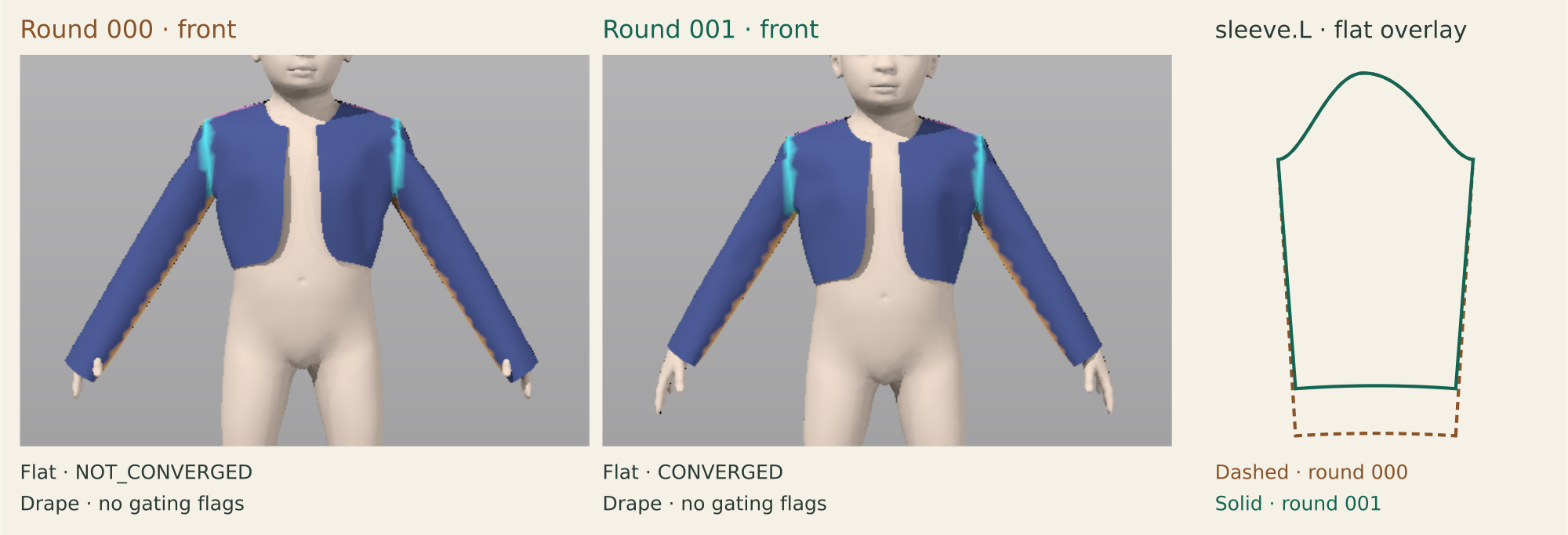
Both drapes settled. In the first front view, most of each hand was still inside a sleeve. A pixel at the left cuff traced back to the hem edge of the sleeve pattern piece. Shortening the draft from 385 to 335 mm exposed the hands while keeping the sleeve cap and body cut.
The revised sleeve is 15 mm longer than the reference arm. Both runs used the same pose, material and body measurements. A wearing trial would establish how the cuff sits on a person.
Why it exists
A drawing is not a pattern.
An image model will happily draw a convincing pattern sheet for a child’s costume. The pieces look right, the labels look right, and the dimensions are printed neatly beside each edge. Then someone measures it.
A pattern has to be checked as geometry, and then on a body, before anyone cuts cloth. An earlier Python tool already did the first part. Its body was a stack of ellipses, though, and its cloth simulation could not say whether an elastic waistband holds. FrankenTextiles replaces both and rebuilds the rest in Rust, tested against that earlier tool case by case.
From a tape measure to cut cloth
How a pattern gets made.
Five steps, and each one shows its work.
- 01
Measure
Start with what you know about the wearer: a few tape measurements, a photograph with a sheet of paper for scale, or only an age and a height. Each value keeps its uncertainty and where it came from.
GivesMeasurements with a source
Measure from a photo - 02
Fit a body
A body model that covers newborn to adult is fitted to those measurements, read the way a tape reads them. Anything it fills in without a measurement is labelled as the model’s estimate.
GivesA fitted body and what it could not match
Change the figure - 03
Draft or trace
Draft a garment to the measurements, alter a pattern you already have, or trace a drawn or scanned sheet. Every seam is walked and every fit point is checked on the flat pattern.
GivesA pattern whose seams match
Draft a bolero - 04
Sew and drape
A cloth solver sews the pieces together around the fitted body, with contact and friction. It reports whether the seams close, where the cloth runs tight, and whether an elastic holds.
GivesA draped garment and its flags
Watch it sew - 05
Cut and stitch
Print tiled pages at home, send one large sheet to a copy shop, or hand a cutting service its DXF. Plotters, cutting machines and embroidery machines each get their own file, and every file is checked before it is written.
GivesFiles for people and machines
Lay out the roll - Then
Make a muslin
Nothing computed can show that a garment fits a person. Sew a test garment in cheap cloth before you cut the good fabric.
The body
A body, not a dress form.
The usual wearer is a small child, and a child is not a scaled-down adult.
The body comes from Anny, a parametric model from NAVER LABS Europe that covers newborn to elderly, with height for age calibrated to World Health Organization data. FrankenTextiles ports its forward model to Rust and matches the original on sixteen reference bodies.
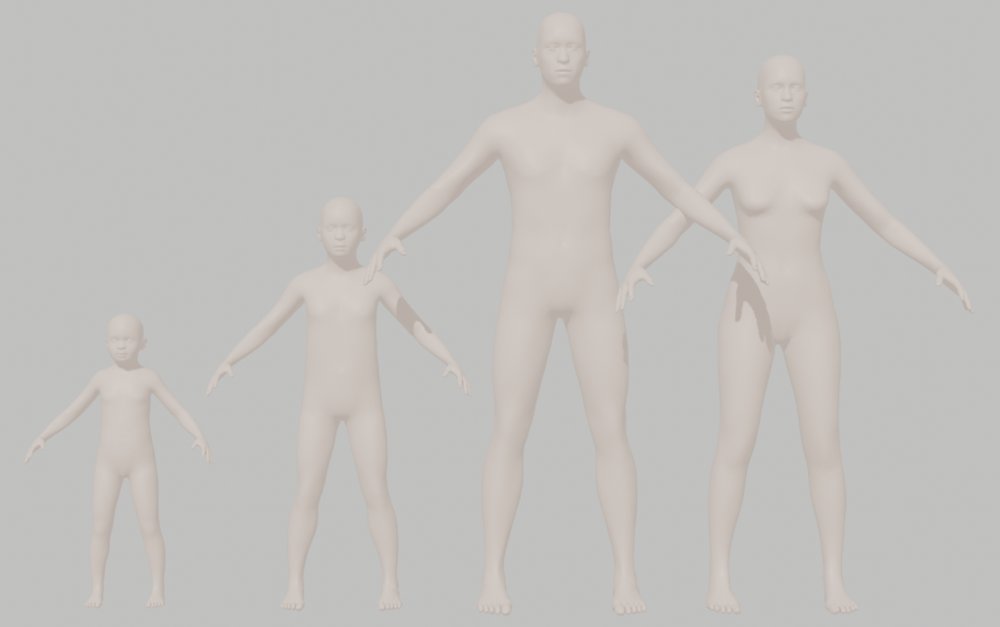
It is fitted from age, sex and height alone, from weight, or from any of 21 tape measurements: chest, waist, hip, thigh, arm length, back length and more. A girth is read the way a tape reads it, bridging hollows instead of following them.
The fit reports what it could not match. Every value it reads off the fitted body without a measurement behind it is labelled MODEL_FIT, never “measured”. That label matters: a body fitted to height alone came out 62 to 75 mm too small around the chest, waist and hip of the 92 cm reference toddler.
The drape
Sewn together, on that body.
The pieces leave the pattern board, wrap around the figure, join at their seams and settle under gravity.
The cloth has its real thickness, stretches differently along and across its grain, and touches the body and itself without passing through. Seams are joined exactly. That lets the simulation answer the questions a sewist would ask.
Does the elastic hold?
A waistband is judged by the elastic’s grip on the body against the garment’s weight. On the trousers, an elastic no longer than the waist holds and one 20% longer does not, and the report says so.
Is it tight?
The earlier simulation had to shrink the body, or every girth gained 4.4 cm. This one does not, so clearance and strain can be read directly.
Has it settled?
Every solver step must converge, and the cloth must stay nearly still for three steps in a row. If it does not, the result carries a flag.
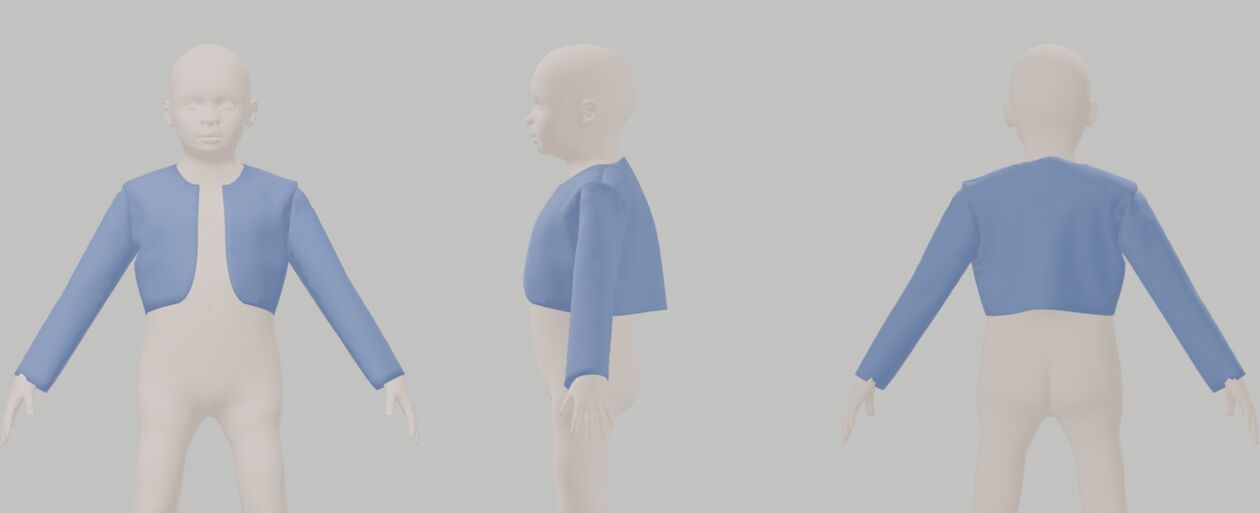
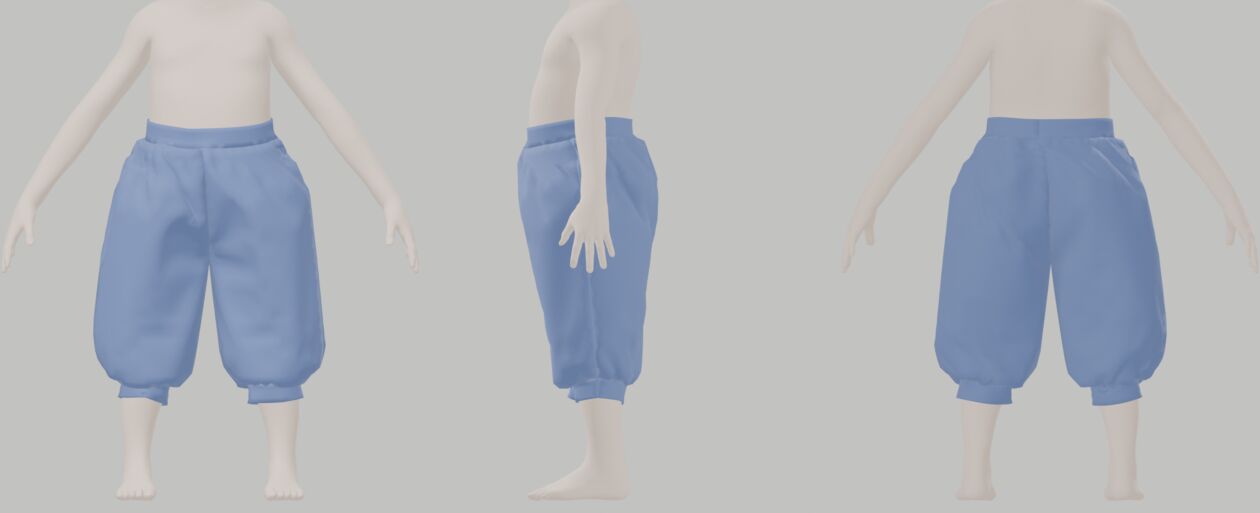
Where the correct answer is known from physics, the solver is tested against it: a ring of cloth on a cylinder holds below a calculated load and slides above it, and a hanging strip bends within 1.5% of the exact curve. The same garment gives the same result, bit for bit, on the command line and in a browser.
What a result means
Four claims, kept apart.
They are never averaged into one score. A drape with no warning flags is a prediction, not a fit.
Parity
A ported part behaves like the reference it replaces.
Established byFixtures captured from the pinned reference, never regenerated from the port.
Physics
The solver behaves like cloth where the answer is known.
Established byKnown-answer tests: a ring on a cylinder, a ring on a cone, a cantilever strip.
Fit
A garment fits a real person.
Established byA muslin or a photograph of the garment worn. Nothing computed does.
Performance
A workload runs in a stated time.
Established byA benchmark that names its machine, its inputs and its spread.
Honest status
Where it stands.
In development. The plan names gates that can stop the body port or the cloth solver early. As of 18 November 2026:
- G1 · Body
- The Rust body model stays within 0.05 mm of the model it was ported from, and fitting recovers synthetic tape targets within 3 mm.
Passed 12 October 2026 - G2 · Drape
- The known-answer tests pass, and real garments settle on fitted bodies within budget.
Passed historically · qualification open - G3 · Port
- Patterns, validation, drafting and exports pass their fixtures, and a full round runs through the command-line tool.
Passed 13 October 2026 - G4 · Browser
- The browser build matches the reference on its 25 cases and drapes garments bit-identically to the command line.
Passed historically · qualification open - G5 · Gauntlet
- A multi-round audit of parity, physics and the whole surface.
Required before version 1.0
Two checks still fail: the strict fit check against chart sizes, and one fitted drape that no longer matches its recorded result bit for bit. Full qualification, including physical fit and performance, remains open.
One timing has been measured properly. In a browser on an Apple M5 Ultra, over 20 runs each, the bolero drape took 16.7 s at the median and the trousers 46.0 s. That is one machine and one workload, and is not a comparison with other software.
Read the full parity status for what is present, partial and missing.
Inside
Ten Rust crates.
No unsafe code, and no Python, C or C++ at run time. The browser workbenches run the same crates.
ftx-core- Units, deterministic maths, curves, polygons, schemas and structured refusals.
ftx-pattern- The pattern model, validation, alteration, drafting and the sourced material catalogue.
ftx-body- The Anny body model, tape-style measuring, fitting and poses.
ftx-measure- The measurement catalogue, priors, fusion, readiness, photo scale and photogrammetry.
ftx-drape- The garment scene, the contact cloth solver, heat and moisture transport, metrics and flags.
ftx-export- SVG, PDF, DXF, HPGL, cutter files, GarmentCode, DST, cutting and sewing planners, acceptance checks.
ftx-trace- Tracing pattern sheets, printable calibration sheets and image decoders.
ftx-cli- The ftx and ftx-materials command-line tools.
ftx-wasm- Browser bindings for the workbenches.
ftx-conformance- Reference, known-answer, property and determinism tests.
Scope and privacy
What it is not.
- Not a drawing program with a curve editor.
- Not a fashion renderer. The figures on this site are for inspection.
- Not a body scanner.
- Not a general cloth simulation library.
- Not a replacement for a muslin.
Because the usual wearer is a young child, no real person’s measurements, photographs, videos or name appear anywhere in the project. Examples use synthetic bodies or a reference wearer built from published population data. Everything runs on your own device, and the workbenches upload nothing.
Questions
Asked often.
Does a passing result mean the garment fits?
No. It means the pattern is consistent, meets its fit targets on the flat, and sews together on the fitted body without a warning flag. Make a muslin.
Why a simulation at all, if only a muslin proves fit?
It catches the failures that waste cloth: seams of different lengths, a sleeve cap that cannot be set in, trousers that slide down because the elastic is too long. Those are cheaper to find before cutting.
Why the Anny body model?
It covers newborn to elderly, and its code and assets are licensed for any use (Apache 2.0 and CC0). The better-known alternatives are restricted to non-commercial use or cover infants only.
Why does it run on the processor and not the graphics card?
A garment here is a few thousand points. Getting contact and friction right, and getting the same answer every time, matters more than raw speed. A processor-based solver also runs unchanged in a browser.
Why Rust?
It gives a solver that returns the same result on every machine, a single program to install, and a browser build with nothing else to download. The earlier Python version remains the reference each ported part is checked against.
What does it cost?
Nothing. The source is public under the MIT licence with an added rider; read the licence file for the terms.